
" height="14.000000381469725px" id="U1XkoOSsK" transform="translate(1.5 5)" width="21.099999999999998px"/></svg>)

Danny Corprew
Dec 22, 2025

Communications sits closer to public perception than any other function in an enterprise, and is why comms leaders are usually the first to sense when something is shifting in the brand. While they can’t always see the root cause, the signs in their operations surface before other functions: the cost of visibility keeps increasing, PR wins don’t carry the brand as far, risks surface later than they should and investments get more difficult to prove. Seeing these signals individually is one thing, but if they start to converge it is often a signal of something much deeper.
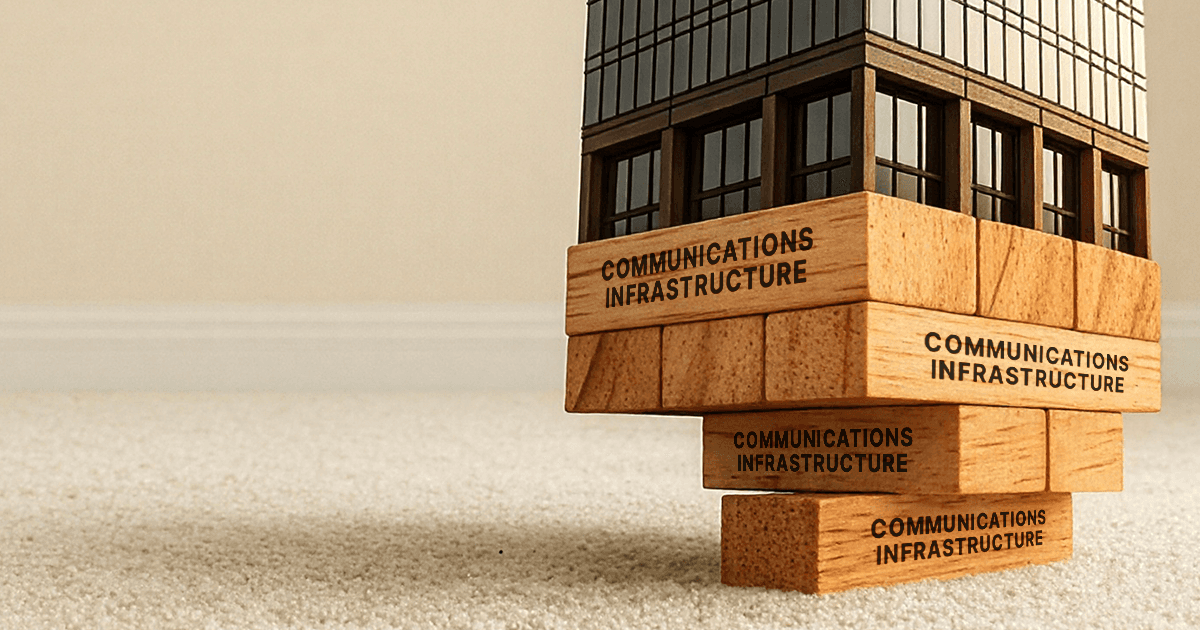
The shift you are feeling is your communications infrastructure showing its age.
The shifting feeling begins in a place most leaders don’t think to look - the infrastructure. Your communications infrastructure is the system of tools, data pathways, processes, and signals that shape how the brand is interpreted and how visible, coherent, and machine-readable it becomes in an AI-driven world. For years, legacy enterprises succeeded without a true digital foundation; size, authority, and budgets compensated for whatever the infrastructure lacked. Brands could dominate search, shape perception, and command attention without the structural clarity modern visibility now requires.
Today, generative engines have flattened the advantages that once insulated established brands. The conditions that previously compensated for structural weaknesses; authority, budget, and historical presence no longer guarantee visibility or narrative control. The landscape has shifted in a way that rewards clarity over size, structure over scale, and interpretability over legacy. When AI systems can’t interpret a brand’s content, they default to whatever structured information they can find. And with AI-generated summaries now capturing most user attention, this is increasingly where reputational drift begins.
AI isn’t the cause for shifts in the foundation; it’s revealing that the one in place was never built for today’s environment.
Communications managers feel the shift first. Working closest to the systems, they see when strong work stops translating into the impact they are use to seeing. Dashboards keep showing green, deliverables look good, but the link between effort and outcome becomes harder to verify. What they don’t see is that infrastructure isn’t carrying the work the way it used to, and they feel that before anyone else.
Eventually the pressure starts to build for senior comms leaders. They find themselves buying more impressions to maintain performance, even as data behind those investments get harder to trust. Like the comms managers, the agency reports insists progress is steady, but operational reality says otherwise. And when budget pressure builds, the cuts typically fall on infrastructure because it is furthest from reach they’ve grown dependent on. That’s how the cycle accelerates: visibility becomes more expensive, insight becomes harder to access, and teams end up carrying the weight of a system showing its age.
What you’re feeling is real, and AI will continue to amplify the structural weaknesses in your comms strategy.
Brands with an outdated communication infrastructure now compete in a landscape where machine interpretability, and digital behavior decide who and what gets seen. The impact is unavoidable: in our enterprise work, we’ve seen brands lose up to 80% of their organic visibility, while industry-wide data shows an average decline closer to 60%. Not because the strategy is weak, but because the infrastructure failed to evolve.
Fix the foundation, stabilize your comms.
If you’re looking for stability, you won’t find it by adding more volume to one side. You’ll find it when you improve your infrastructure.
Other posts you might be interested in

" height="9.023611121376353px" id="fd5ctDH1K" transform="translate(15.411 3.44)" width="58.19722612169055px"/><path d="M 5.678 11.863 C 5.069 11.863 4.461 11.863 3.954 11.761 C 3.751 11.761 3.447 11.863 3.447 12.167 L 3.447 13.485 C 3.447 13.688 3.549 13.89 3.751 13.89 C 4.258 13.992 4.968 14.093 5.678 14.093 C 7.604 14.093 9.226 13.485 9.226 12.775 L 9.226 11.66 C 9.226 11.457 9.024 11.254 8.821 11.356 C 7.908 11.66 6.793 11.863 5.678 11.863 L 5.678 11.863 L 5.678 11.863 Z M 5.678 8.517 C 5.069 8.517 4.461 8.415 3.954 8.314 C 3.751 8.314 3.447 8.415 3.447 8.719 L 3.447 10.139 C 3.447 10.342 3.65 10.544 3.853 10.646 C 4.625 10.814 5.069 10.849 5.678 10.849 C 7.097 10.849 8.314 10.646 9.125 10.24 C 9.835 9.936 10.342 9.429 10.342 8.922 L 10.342 8.01 C 10.342 7.807 10.139 7.604 9.835 7.706 C 8.719 8.212 7.199 8.517 5.678 8.517 L 5.678 8.517 L 5.678 8.517 Z M 11.356 3.042 C 11.356 1.419 8.719 0 5.576 0 C 2.433 0 0 1.318 0 3.042 L 0 11.051 C 0 11.964 0.71 12.775 1.825 13.282 C 2.028 13.282 2.231 13.282 2.231 13.079 L 2.231 3.042 C 2.231 2.028 3.751 1.217 5.678 1.217 C 7.604 1.217 9.125 2.028 9.125 3.042 C 9.125 4.056 7.604 4.867 5.678 4.867 C 3.751 4.867 4.562 4.867 4.056 4.664 C 3.751 4.664 3.447 4.765 3.447 5.069 L 3.447 6.489 C 3.447 6.692 3.65 6.996 3.853 6.996 C 4.625 7.22 5.069 7.199 5.678 7.199 C 6.996 7.199 8.213 6.996 9.125 6.59 C 9.835 6.286 10.443 5.881 10.849 5.374 C 11.153 4.968 11.356 4.563 11.356 4.157 L 11.356 2.94 L 11.356 2.94 L 11.356 2.94 Z" fill="rgb(255, 255, 255)" height="14.093055589864148px" id="JrgcUMrdf" transform="translate(0 0.905)" width="11.355555555555554px"/></svg>)